

The Source Is: http://www.scribd.com/doc/17436831/The-Small-Business-Guerrilla-Guide-to-Six-Sigma
Showing posts with label Six Sigma For Small Business. Show all posts
Showing posts with label Six Sigma For Small Business. Show all posts
Why Six Sigma is an All-Or-None Proposition
A “toe in the water” approach won’t always tell you if six sigma will work.
| Recently some prospective clients asked me for a demonstration project to help them determine if six sigma would be a good idea at their company. I advised them against it. Such a demonstration only shows management’s lack of commitment to the success of six sigma. |
Although philosophical issues are important, there are more concrete problems with such “toe in the water” projects. In particular, major quality improvements can sometimes yield little or no bottom-line cost impact. The result of such projects is to convince management that six sigma adds cost without adding value. This belief is, of course, totally wrong. But it’s also a logical result of the demonstration approach itself.
For example, Sam was a six sigma enthusiast. He’d studied its use at several major companies and was convinced that it would save his company, which we’ll call Acme, millions of dollars. The hype had also caught the attention of the senior leadership at Sam’s company. But before diving headlong into six sigma, they wanted Sam to conduct a demonstration project to see if the savings reported by the press could actually be obtained at Acme.
The company’s main product was a complex assembly, which Acme sold to a large aerospace customer. The assembly- manufacturing process was in statistical control and producing an average of 10 defects per assembly. With management’s support, Sam documented the cost of noncompliance to be about $1,000 per assembly. After months of diligent effort, Sam’s six sigma team was able to redesign the process. To their delight, they were able to reduce the number of defects per assembly by a full 50 percent, from 10 defects per assembly to five.
Management was also interested in the project. But the accounting department had carefully monitored the costs for the assemblies, and to everyone’s surprise, accounting found only a minuscule 0.7-percent cost savings.
Based on these results, leadership’s conclusion was simple: Quality doesn’t pay. The company won’t pursue six sigma any further.
Did accounting make a mistake? In a word, no. The problem arose because Sam measured quality as defects. The truth is that most costs are incurred because of defectives rather than because of defects. (Thanks to Mikel Harry of the Six Sigma Academy for this insight.) A defective is a unit of product or service that contains one or more defects. Whether a unit contains one defect or several is irrelevant. Customers generally react to defective units by returning them for warranty repair, refunds or other options. Internally, defective units must be identified through costly inspection and then routed through equally costly rework processes, or else scrapped entirely. A unit with one defect costs nearly as much as one with several.
Mathematically, the Poisson distribution describes the relationship between defects and defectives. The equation for the Poisson distribution is

In the equation, x represents the number of defects in the sample, and P(x) means the probability of finding x defects. For example, P(1) is the probability of finding one defect. The symbol μ is the average number of defects per unit of product or service. For Sam’s project, the average assembly had 10 defects before six sigma was applied, so μ = 10. The efforts of the six sigma team reduced the average number of defects per assembly to 5, for a 50 percent improvement in quality.
Let’s plug these numbers into the equation and see what happens. Because we are interested in the probability of an assembly being defect-free, we want to know P(0) for each of the two quality levels. Before six sigma, with μ = 10 we get

In other words, there were virtually no defect-free circuit assemblies before applying six sigma methodologies. After applying six sigma, the probability of getting a defect-free assembly at Acme was

Thus, a 50-percent improvement in the quality level as measured in defects produces only a 0.7-percent improvement in the number of defect-free circuit assemblies. A complete graph of this relationship is shown in Figure 1.
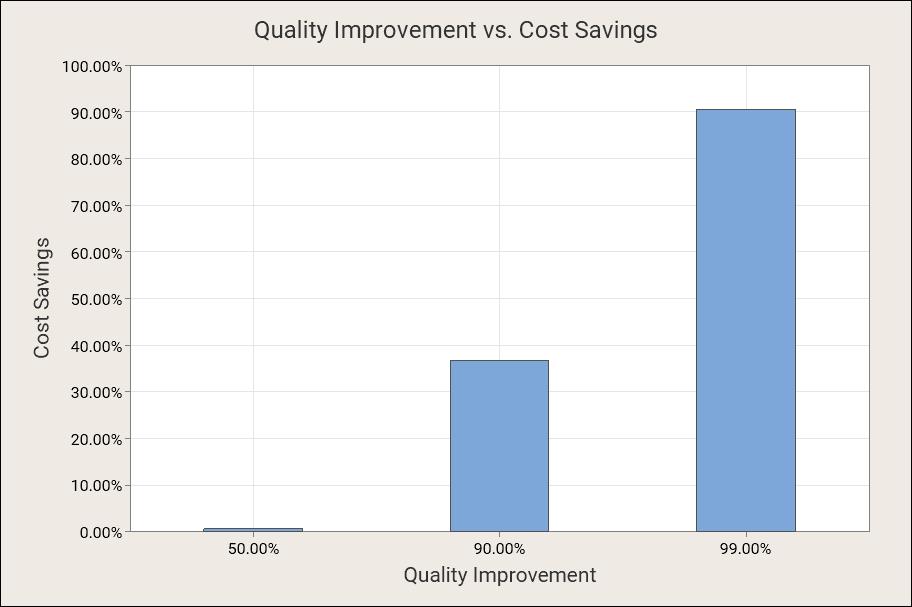
Figure 1-Quality Improvement vs. Cost Savings
The real cost-reduction benefits only start to appear when quality reaches very high levels. This relationship explains the commonly observed phenomenon of quality programs not paying off in the short term. Only when companies stick with it long enough to begin to approach six sigma quality levels do they get the desired results. Too often, “toe in the water” projects scare companies out of the pool before they even start to swim.
The Article Source Is: http://www.sixsigmatraining.org
How To Implement a six sigma program
| The biggest misconception small-business owners have about Six Sigma may be to assume the process-improvement program is useful only for large manufacturers.Nothing could be further from the truth. |
“Six Sigma is a collection of tools to improve processes and is applicable to any kind of business,” says Bob Olson, a Six Sigma instructor at Central Piedmont Community College.
“Six Sigma can benefit service and production companies of all sizes who have identified change as a critical business need,” says Charlotte business coach Cathy Critz, owner of Solutions FYS Inc.
She adds: “A good Six Sigma candidate company is typically customer-driven with defined processes, is comfortable with data and fact-driven management, is open to exploring options and is tolerant of failure. Every option is not successful.
Six Sigma systematically guides companies to define, measure, analyze, improve and control improvement projects and processes. Companies that use it report lower costs, less waste, improved process capability and significantly improved customer satisfaction.
Once you decide Six Sigma can benefit your company, the next step is to decide on the infrastructure you will use to implement it. Will you hire an outside consultant to advise you? Will you hire a black-belt Six Sigma expert (the highest level certification possible) to come to your site and lead the effort?
You may choose to seek training for individual staff members to be certified in Six Sigma techniques. Then you need to decide how many employees need training and at what level.
Programs range from a three-hour executive workshop to familiarize management with the program to 60 hours of classroom and online instruction that also includes direct project experience.
“Don’t over-train your people — keep focused on your goals,” advises Gary Klipp, who developed training software for Six Sigma when he was at The Quality Group. He is now retired from the Charlotte firm.
Critz says many companies choose to bring in a black-belt consultant to oversee the Six Sigma process and to help train personnel who are seeking certification.
If your company is very small, or if you have budget concerns, see if you can team with other small firms for joint training and consulting.
There are other steps to take to ensure your company’s Six Sigma program is effective. Management support is vital, Olson says. “Without management commitment, you’ll only see pockets of improvement. You need to empower your change agents.”
If you don’t, you’ll fail, Klipp says. “You need to free in-house leaders from other tasks and give them authority, as well as a title. If they don’t have authority, they will butt heads with other managers. Teams are usually cross-functional and cross departments, so people from several departments need to be involved.”
Process improvement should be continual, and it needs to become part of the way you do business. But keep in mind that specific projects related to Six Sigma need to have specific beginning and end dates. They may last two weeks to several months.
“The Six Sigma team develops solutions, which are then turned over to an implementation or operations team,” Klipp says.
Never forget the big picture, he says. “Sustainability is the biggest tissue. If improvement is not maintained, you’ll come back three years later to the same problem.”
It’s also important to determine the specific return on investment for each project.
“It can be frustrating if you don’t know your ROI,” Klipp says. “You need to accurately figure out what you expect cost savings to be and then correctly compute and track them.”
TOPTIPS
•Recognize Six Sigma can be effectively utilized by small firms in any industry.
•Be open to change, committed to an ongoing process and comfortable with Six Sigma’s measurement techniques and data analysis.
•Get the advice, support and staff training necessary, but don’t pay for more than you really need.
•Give your staff the authority it needs to get the job done.
Bea Quirk is a Charlotte-based free-lance writer who can be reached at beawrites@aol.com.
The Article Source : http://www.bizjournals.com/charlotte/stories/2008/08/04/smallb4.html
Advanced Six Sigma in Small Business
| Six Sigma is a business management strategy that can be effectively used in many ways by small businesses to improve the overall quality of business operations to achieve faster growth. |
For people who may be less familiar, Six Sigma may be simplistically defined as a form of business management strategy, or more appropriately, a type of business improvement methodology. This methodology was first successfully tried by Motorola during the penultimate decade of the previous century and today has become immensely popular and finds widespread application across many types of industries – not excluding small businesses. Six Sigma Methodology for Small Businesses
Six Sigma attempts to identify all areas of inefficiency and removes all possible causes of failures aimed at improving the overall quality of business operations. Apart from introducing a set of quality control methods, Sigma goes beyond to develop a special team of people within the organization, branded as Black Belts - who are trained to become experts in these methods.
Several well-established organizations including Dupont, Federal Express, General Electric, Johnson and Johnson, Kodak, Sony and Toshiba have implemented Six Sigma steps and achieved remarkable progress within a short span of time.
Although there is a popular misconception that Six Sigma is meant only for major corporate houses, many management professionals opine that on the contrary, it is much easier for small businesses to introduce and successfully implement Six Sigma than larger corporations. Experts further suggest that the basic Six Sigma principles called Six Sigma MAIC (measure, analyze, improve, and control) has no relevance to the size of the business or the number of employees working.
Of course, it has to be conceded that there are a few limiting factors when implementing Six Sigma in small business houses - like resource constraints and lack of capable manpower. But as a compensating advantage, small businesses enjoy flexible process flows, less procedural delays, no cumbersome decision-making chain and transparency of senior management.
Small businesses generally can ill-afford to permanently have full-time Master Black Belts on payroll or hire people with the skills and expertise to step into the role of Black Belts without extensive training. As a start, small businesses can avail the services of a certified Six Sigma consultant to act as the company’s Black Belt till the business expands to generate adequate revenue for training its own staff.
An experienced Black Belt consultant coming from outside will straightaway provide a head-start by immediately implementing Six Sigma. The heartening fact is the financial savings realized after introducing Six Sigma will amply pay for the entire cost of the Six Sigma training.
After initially training some employees of the small business as Green Belts, Six Sigma projects can proceed unhindered with Green Belts executing the Six Sigma processes. Gradually these Green Belts may be trained into Black Belts by the external Black Belt consultant. This type of slow training approach will help many smaller companies to implement Six Sigma at a pace it can more comfortably manage. Small business owners can also draw comfort from the fact that because of the size of a small business, the benefits of Six Sigma will be realized faster.
As a concluding comment, it may be stated that the term "Six Sigma" is a trademark registered and owned by Motorola and Motorola, proudly proclaims that Six Sigma has helped the company saving billions of dollars.
The Article Source : http://www.brighthub.com/office/project-management/articles/38134.aspx
Small Business can benefit from Six Sigma improvements faster than larger corporations
| Did you know that smaller businesses can benefit from Six Sigma improvements faster than larger corporations? Obtain a greater understanding of the advantages of the Six Sigma methodology for your small business requirements. We invite you to explore the possibilities in improving your productivity. See why Six Sigma can work for small businesses like yours. |
It is not surprising that some people may perceive Six Sigma as being only for large corporations. Major corporations such as Allied Signal, Black & Decker, Dow Chemical, Dupont, Federal Express, General Electric, Johnson and Johnson, Kodak, Motorola, Sony, and Toshiba have all rolled out Six Sigma efforts and achieved outstanding results. Yet, it is incorrect to think that Six Sigma process improvement results can only be achieved by huge organizations. Small businesses can also succeed in implementing Six Sigma and reap the process improvement benefits that Six Sigma provides.
Certainly, there are factors that can be disadvantageous for implementing Six Sigma in a small business rather than a large business, such as lack of resources and expertise in change initiatives. However, there are also characteristics inherent in small businesses that can speed up the effective implementation of Six Sigma more than in large businesses, such as flexible process flows, a shorter decision-making chain, and higher visibility of senior management.
Six Sigma can work in any size business because the nature of Six Sigma is dependent upon characteristics inherent to any business, not on the size of a business. Six Sigma MAIC (measure, analyze, improve, and control) disciplines work no matter the size of the organization or even the size of the Six Sigma project.
Small businesses do have constraints that limit their ability to initiate a large scale Six Sigma implementation. However, there are ways to overcome these limitations. Small businesses don't have large reserves of excess cash to earmark for the massive training programs employed by the large corporations in implementing their Six Sigma programs. Small businesses generally can’t afford to have full-time Master Black Belts on staff and may not have the personnel with the skills and expertise to step into the role of Black Belts without extensive training. A certified Six Sigma consultant can act as your Black Belt for the initial projects until you have generated sufficient savings to be able to provide some of those savings for training your own people. Training happens at a slower scale for smaller companies but it still happens. Financially, savings realized from the first set of projects usually justifies the entire cost of the Six Sigma training.
Once some members of the organization have been trained as Green Belts, Six Sigma projects proceed with Green Belts executing Six Sigma processes. Incrementally, Green Belts are developed into Black Belts and new Green Belts are trained. Using a more gradual training approach addresses many of the constraints of smaller companies and allows them to implement Six Sigma at a pace a small business can more easily manage.
There is a benefit to implementing Six Sigma in a smaller business. Because of the size of a small business, the financial results and cultural transformation that stem from Six Sigma will propagate more quickly through a smaller organization. Focusing the Six Sigma tools at virtually any properly scoped project will drive savings to your bottom line and achieve breakthrough change in your organization.
About The Writer:
Peter Peterka is the Principal Six Sigma Consultant in practice areas of DMAIC and DFSS. Peter has over 15 years experience in including implementation of Six Sigma for small business with a variety of organizations. For additional information please contact Peter Peterka at Six Sigma us.
By Peter Peterka
The Article Source : http://www.buzzle.com/editorials/8-12-2005-74754.asp
The Complete Guide To Six Sigma For Small Business: What is Six Sigma?
In This Article and all The Future Articles, We Will Walk About Six Sigma Technique For Small Business, We Will discover the power of This that based on Reduce Fails , and Maximize performance. Do you think its easy?, Read The Full Articles And Find The Answer.
Six Sigma is defined as a type of business improvement methodology. Its main objective is to implement a vigorous process to systematically eliminate defects and inefficiency. It was originally developed by Motorola in the early 1980's and because of its proficiency has become extremely popular in many corporate and small business environments around the world.
Six Sigma's main purpose or objective is to deliver high performance, value and reliability to the customer. It is regarded and used around the world as one of the major themes for TQM (Total Quality Management).
Six Sigma was developed by Bill Smith at Motorola in the early 1980's. It was originally designed for a way to measure defects and to improve overall quality. A major position of Six Sigma is that by using the methodology, it can lower defects to a level of 3.4 DPMO (defects per million opportunities). 3.4 DPMO can also be written as plus or minus six sigma when the centerline spans 12 sigma positions. (Six Sigma comes from a technical term used in statistics)
While originally developed for quality control, Six Sigma is used in many different ways, such as improving communications with customers, employees and shareholders and improving the total process of interaction, communication and product design.
It should be noted that the term "Six Sigma" is a registered trademark, owned by Motorola. According to Motorola, this methodology has saved the company over 17 billion dollars from its inception to 2006.The Six Sigma Methodology
The Six Sigma includes two key methodologies; DMAIC and DMADV. DMAIC is used for an existing process. DMADV is used when creating a new product or process. Using DMADV for new projects can usually result in a more predictable process and ultimately higher quality product.
DMAIC
There are 5 important steps included in DMAIC. They are:
* D - Define goals to improve the overall process between your company strategy and your customer's demands (can also refer to your group and the groups or individuals that you support).
* M - Measure your current processes. Collect relevant data on your current processes and then use this data as a baseline for future comparisons.
* A - Analyze your relationship within the process. It is important to understand the relationship to determine factors that can ensure you keep your companies strategy in line with your customers demands.
* I - Improve the process. It is important to constantly improve and optimize the process, using analysis and other techniques. One technique that is often used is Design of Experiments. (This is a technique that can help to test a hypothesis, using acceptable experimental design).
* C - Control. It is important ensure that you can control and correct any variances avoiding possibly costly defects and loss of quality. Many times pilot runs are set up to study process capability and production transition. These pilot runs can help fine tune or add additional control mechanisms.
DMADV
There are 5 important steps included in DMADV. They are:
* D - Define goals that are consistent between your business strategy and customer demands.
* M - Measure CTOs (critical to qualities) CTOs consist of production process, capabilities producing a product, the capability of a product and any risk assessments.
* A - Analyze and evaluate many different designs, choosing the best design for its overall qualities.
* D - Design details. It is important not only to design a product, but optimize the design features. In order to fully optimize a design feature, you may be required to create multiple designs or simulations.
* V - Verify the design. Important steps to verifying a design include setting up pilot runs and running a short production. This step also requires you to handover the design to process owners.
Statistics
Statistics is at the core of the Six Sigma methodology. Six Sigma focuses on using data to problem solve and create systematic approaches to lowering deficiencies. Because data is at the core of the Six Sigma methodology, statistical analysis and tools are commonly used. It is important to note that while the Six Sigma methodology is data driven at its core, rudimentary statistical tools and analysis are usually proficient.
Implementation of Roles in Six Sigma Methodology
There are many roles that that are used in the Six Sigma Methodology. While most of the roles below are used in many organizations Six Sigma implementation, it should be noted that they are not universal. The roles include:
1- Executive Leadership - Top level executives are responsible for vision and ultimately implementation of the Six Sigma Methodology. They also empower others to take initiative and ownership of the Six Sigma principles.
2- Champions - Champions are usually upper management that is responsible for the implementation of Six Sigma throughout their organization.
3- Master Black Belts - are usually hand picked by Champions to coach others within the organization on the Six Sigma methodologies. They allocate either all or most of their time to the Six Sigma methodologies. It should also be noted, that they usually have mentoring responsibilities to coach and train lower roles including Black Belts and Green Belts (see below)
4- Experts - while this role is not in every organization, it can play a huge role in major engineering or manufacturing sectors. They improve overall services, products, and processes for their end customers.
5- Black Belts - Black Belts focus on six sigma execution. They are usually middle managers.
6- Green Belts - These roles are usually taken on by employees who help Black belts execute specific projects, as well as other job responsibilities.
Downsides of the Six Sigma Methodology
For the vast majority of organizations, the Six Sigma methodology has helped them be competitive and reduce costs; however it should be noted that there are some downsides that do exist.
In order to implement the Six Sigma methodology in an organization, it is extremely important to have buy- in from employees on all levels. If associates, middle managers or high level executives are not enthusiastic about using the Six Sigma Methodology, it can ultimately lead to failure.
Another downside of using Six Sigma is that in some instances, Six Sigma's effectiveness has never been measured or is unable to be measured. Due to the inability of measurements, it is unclear if Six Sigma is actually helpful.
Finally, many organizations use the Six Sigma methodology as a way of protecting themselves from liability. For instance, if a company produces a product that is low in quality or can harm its user, the organization can use the defense that quality is at the forefront in order to be viewed positively. In this respect, it is unclear if an organization has implemented Six Sigma for its methodology or to cover its liability.
The Article Source: http://www.tech-faq.com
Subscribe to:
Posts (Atom)


